
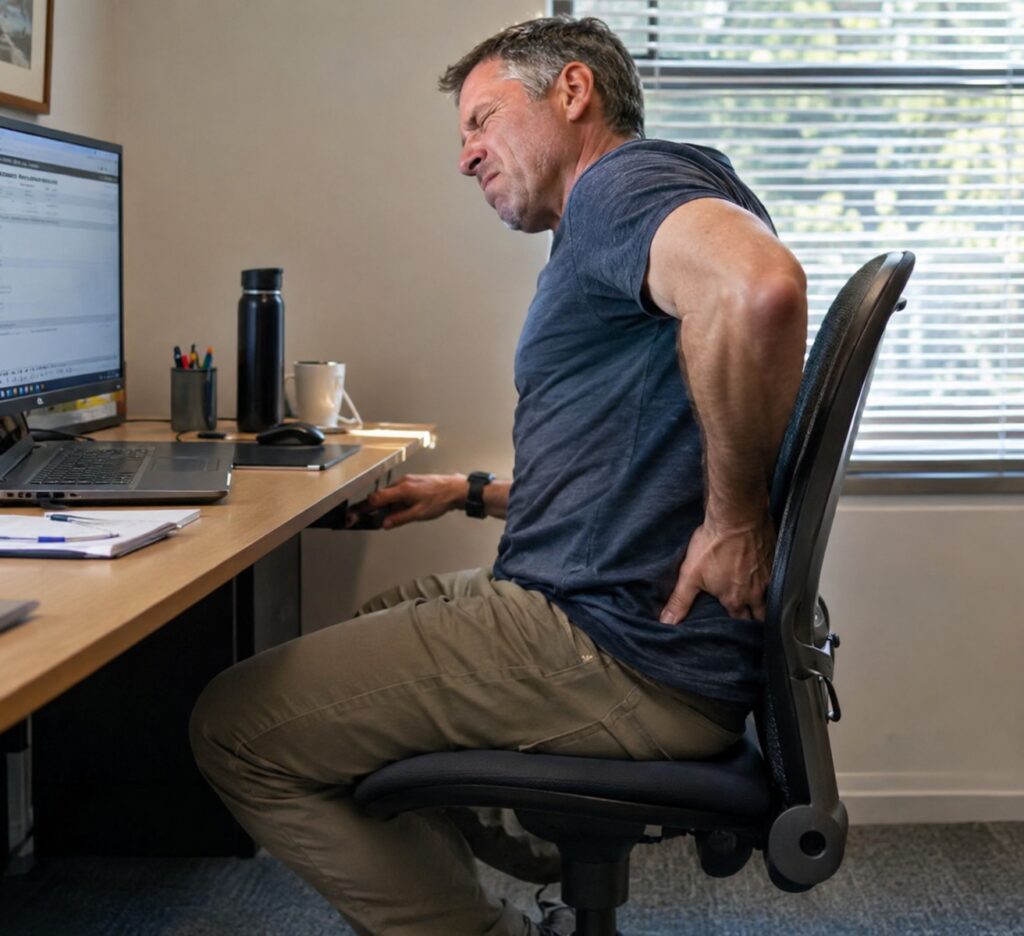
If you’ve been dealing with back pain from your office chair, you’re not alone, and you’re not imagining it. Whether you’re working from a home office in Lake Macquarie or sitting at a desk in Newcastle’s CBD, the wrong chair (or the right chair used the wrong way) is one of the most common causes of lower back pain we see across the Hunter region.
Why office chairs cause back pain
Most office chairs aren’t the problem on their own; it’s the combination of poor support and long, unbroken periods of sitting that does the damage. Your lower spine has a natural inward curve, and when a chair doesn’t support that curve, your pelvis tends to slump backward. This flattens the curve, puts extra strain on the discs and muscles of your lower back, and over weeks and months, that strain turns into chronic pain.
Common culprits include:
- Inadequate or badly positioned lumbar support. Support that sits in thewrong spot often does more harm than good.
- Sitting too long without moving. Even a perfectly set up chair can’t compensate for eight hours of stillness.
- Incorrect seat height or depth. If your thighs aren’t roughly parallel to the floor, or there’s pressure behind your knees, it changes how your pelvis sits.
- No footrest when you need one. Shorter users especially can end up with feet dangling, which pulls the pelvis out of a neutral position.
- Chairs chosen for looks rather than function. A stylish chair with no real adjustability is a common trap, and it’s one we see constantly.
There’s also a compounding effect that people don’t always expect. Poor sitting posture doesn’t just load up your lower back; it changes how your shoulders, neck and hips sit too. So what starts as lower back discomfort can gradually spread into stiffness through the upper back or tension headaches, simply because the whole body is compensating for a poor base position.
Quick fixes you can try today
Before you assume you need a whole new chair, there are a few things worth checking first. None of these cost anything, and for a lot of people they make a genuine difference within a week or two.
- Adjust your lumbar support so it sits in your lumbar curve and not across your pelvis.
- Set your seat height so your forearms sit parallel to your desk.
- Check for a finger-width of space between the back of your knee and the front of the seat.
- Get up and move every 30 minutes, even just to stand and stretch for a minute.
- Avoid perching on the edge of your chair; use the backrest properly rather than fighting it.
- Check your monitor height. If you’re tilting your head down or craning it forward to see the screen, that habit alone can undo good chair setup.
When it’s time for a proper assessment
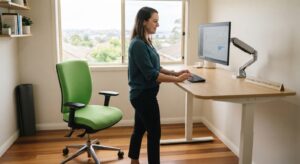
If you’ve made these changes and you’re still getting back pain from your office chair, the issue may be less about habits and more about the chair itself, or how your whole workstation is set up together. Desk height, monitor position and chair adjustability all work as a system, and getting one part wrong can undo the benefit of fixing another. This is often where people get stuck: they’ve bought a good chair, but it’s never been properly adjusted for their body, or it’s paired with a desk that doesn’t suit it.
This is exactly the kind of thing we work through with clients across Newcastle, Lake Macquarie and the broader Hunter region every week, whether that’s a single home office setup or a full workplace assessment plan covering a whole team.
Ready to sort your setup once and for all?
If your back pain has been dragging on and you’re not sure whether it’s your chair, your desk or your habits, it’s worth talking it through properly rather than guessing. Give Ergo Experts a call on 0409 512 434 to chat about what you’re experiencing and arrange an assessment if it makes sense for your situation.