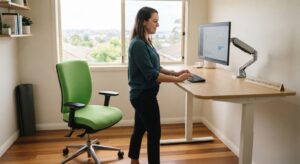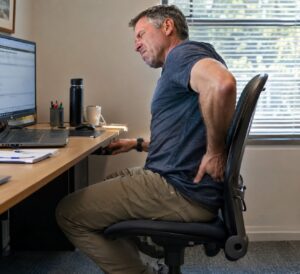

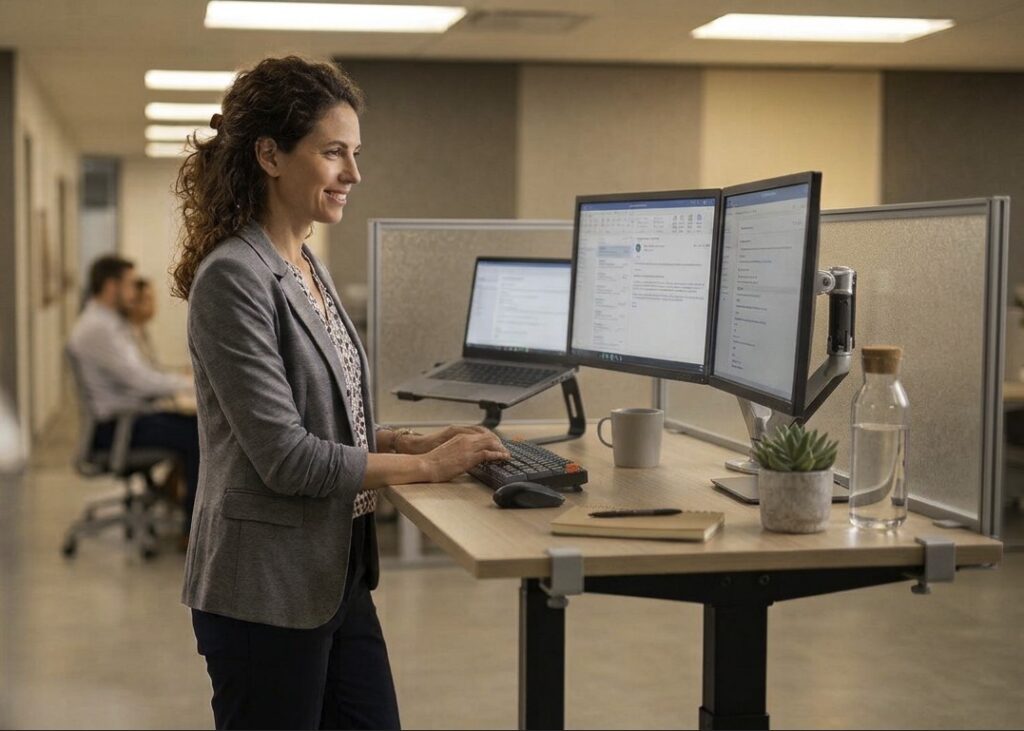
“Should I be standing at my desk?” It’s one of the most common questions I get during workplace assessments around Newcastle and Lake Macquarie. Standing desks have gone from novelty to normal in just a few years, and plenty of people now assume that when it comes to sitting vs standing at work, sitting is the enemy and standing is the cure.
The truth is a bit more interesting than that. After 30 years as a physio, here’s my take, backed by some recent research that’s worth knowing about.
Is sitting really that bad?
Sitting itself isn’t the problem. Sitting still for hours on end is. Your spine, hips and neck are built to move. When they’re held in one position all day, tissues stiffen, circulation slows and discomfort creeps in. By 3pm that shows up as a sore lower back, tight shoulders, or a heavy tiredness that has nothing to do with how hard you actually worked.
But here’s the catch: standing still all day isn’t the answer either. Swap eight hours of sitting for eight hours of standing and you’ll trade a sore back for sore feet, heavy legs and, quite often, a different kind of back pain. The goal isn’t to pick a side. It’s to keep changing position.
What a 6-month sit-stand desk study found
A 2024 randomised controlled trial published in the journal Ergonomics followed 38 office workers, aged 24 to 60, for six months. One group was given a sit-stand desk. The other group carried on with their usual setup.
Importantly, the desk group didn’t just get a desk and a “good luck”. They also received:
- an education session on why breaking up sitting matters
- regular motivational prompts to keep using the desk
- guidance on posture and on gradually building up their standing time
After six months, the sit-stand desk group reported less musculoskeletal discomfort overall and less post-work fatigue (that wiped-out feeling at the end of the day). The control group showed no change. The researchers suggested that adding at least 30 minutes of standing a day was enough to make a difference, and that more standing time may particularly help low back pain.
To be fair to the science, the difference between the two groups didn’t reach statistical significance, so this is a promising result rather than a slam dunk. The authors also noted that people responded quite differently to the same intervention. Some did really well, others less so.
That last point is the one I find most useful.
Why the same desk works for one person and not another
In my experience, a sit-stand desk tends to fail for predictable reasons:
- It’s set at the wrong height in one or both positions, so standing gets uncomfortable within minutes
- The chair isn’t set up properly, so sitting is still uncomfortable when you go back to it
- Nobody showed the person how to build up standing time, so they overdo it, get sore and give up
- Within a few weeks it becomes a very expensive fixed-height desk
Notice that the study group had support built in: education, prompts and individual guidance. That’s the bit most workplaces skip. They buy the hardware and hope for the best.
How long should you stand at your desk?
If you’ve got a sit-stand desk, or you’re thinking about one, here’s where I’d start:
- Start small. Aim for an extra 30 minutes of standing a day, split into short blocks, and build from there.
- Change position every 30 to 60 minutes. Sit, stand, walk, repeat. Movement beats any single posture.
- Set both heights properly. Elbows at roughly 90 degrees with relaxed shoulders, whether you’re sitting or standing, and the top of the screen around eye level.
- Use cues. Stand for phone calls, Teams meetings or working through your inbox.
- Look after your feet. Supportive shoes and an anti-fatigue mat make a big difference.
- Don’t undo it at home. The same research group found some people made up for standing at work by sitting more in their spare time. Standing at your desk isn’t a licence to spend the evening on the couch.
Where an ergonomic assessment fits in
That variation between individuals is exactly why a one-size-fits-all approach falls short. An ergonomic assessment looks at you: your body, your symptoms, your tasks and your workstation, and sets things up to suit.
A physio-led assessment goes a step further. As well as adjusting your chair, desk and screens, I look at why you’re sore, whether there’s something underlying it, and what’s realistic for you. If a sit-stand desk makes sense, I’ll set it up properly and give you a plan to build up your standing time without flaring things up. If it doesn’t make sense, I’ll tell you, and save you the money.
For employers, it’s a simple way to reduce discomfort and fatigue across a team, and to make sure the money spent on equipment actually pays off.
Ergonomic assessments in Newcastle, Lake Macquarie and the Hunter
At Ergo Experts, I provide physio-led ergonomic and workstation assessments for businesses and individuals across Newcastle, Lake Macquarie and the wider Hunter region. Whether you work in the office, at home or a bit of both, I’ll come to you, assess your setup and leave you with practical changes that make a real difference.
If you’re sore at your desk, weighing up a sit-stand desk, or want your team set up properly, give me a call on 0409 512 434 to talk it through or arrange an assessment.
FAQ
Is it better to sit or stand at work? Neither on its own. The best approach is to alternate regularly between sitting, standing and moving, changing position every 30 to 60 minutes.
How long should I stand at my standing desk? Start with an extra 30 minutes of standing a day, split into short blocks, and build up gradually. A 2024 study in Ergonomics found benefits for discomfort and fatigue from adding at least 30 minutes of standing a day.
Can a standing desk help lower back pain? It may. Research suggests more standing time may benefit low back pain, but results vary between people. Getting the desk height, screen and chair set up correctly matters as much as the desk itself.
What happens in an ergonomic assessment? A physio reviews your symptoms, your work tasks and your workstation, then adjusts your chair, desk, screens and keyboard to suit you. You’ll get practical recommendations, including whether equipment like a sit-stand desk is worth it.
Do you offer ergonomic assessments in Newcastle and Lake Macquarie? Yes. Ergo Experts provides physio-led ergonomic and workstation assessments across Newcastle, Lake Macquarie and the Hunter region, at your office or home. Call 0409 512 434 to arrange one.
Reference: Silva H, Ramos P, Teno S, Júdice P (2024). Impact of a 6-month sit-stand desk-based intervention on regional musculoskeletal discomfort and overall post-work fatigue in office workers: a cluster randomised controlled trial. Ergonomics. Read the study